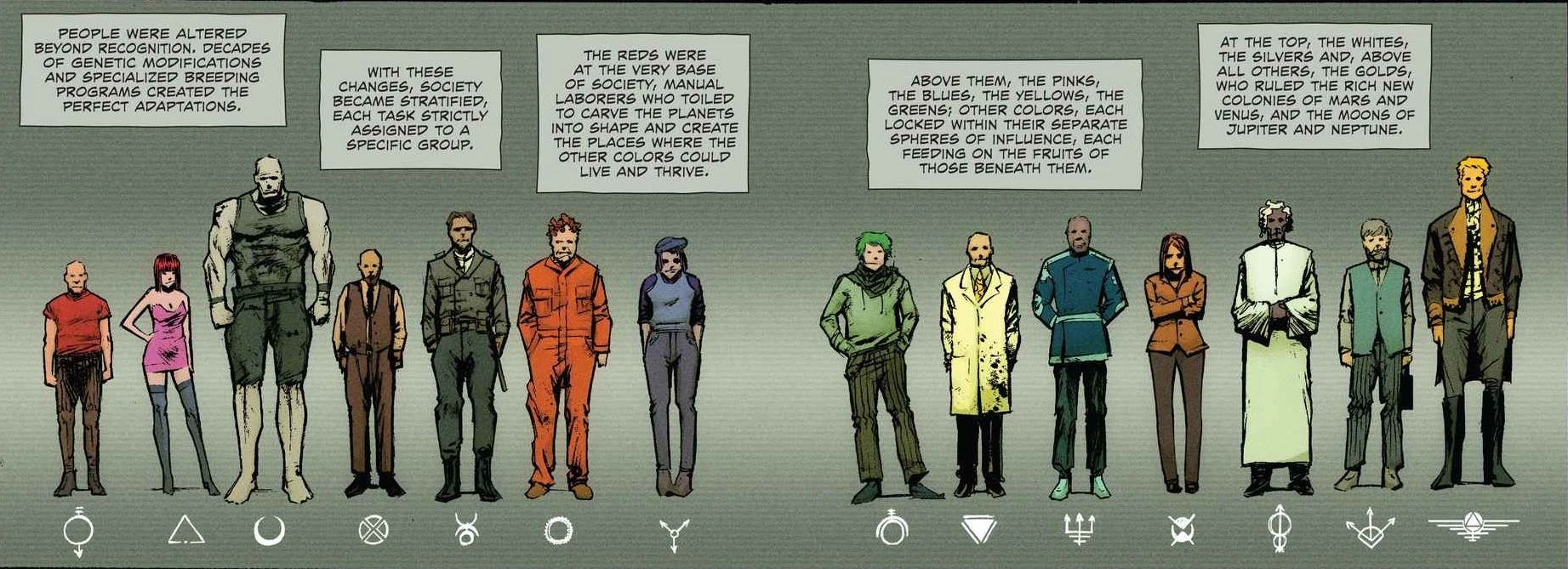
The Color system of The Society is a hierarchical caste system developed during the early days of humanity's space colonization efforts that has come to dominate all human civilization across the solar system. The system divides humanity into fourteen distinct classes, color-coded based on each caste's designated role in society.
Description[]

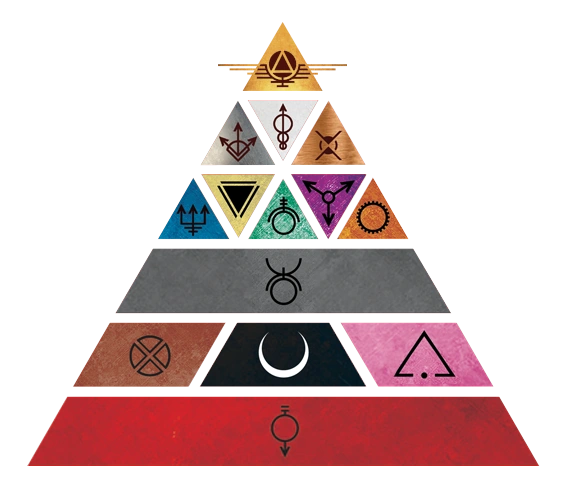
The Color hierarchy is commonly visualized as a pyramid depicting each caste of the hierarchy. From left to right, top to bottom, the colors and their roles are as follows:
- Gold: Rulers of the society
- Silver: Financiers and businessmen
- White: Clergy and judges
- Copper: Administrators, lawyers and bureaucrats
- Blue: Bridge crew of starships and pilots
- Yellow: Doctors and researchers
- Green: Programmers and technicians
- Violet: Artisans and other creatives
- Orange: Mechanics and engineers
- Gray: Regular soldiers and police
- Brown: Servants, cooks, janitors
- Obsidian: Elite soldiers and bodyguards
- Pink: Pleasure slaves and social functionaries
- Red: Manual laborers and miners
Within each color there are often multiple tiers marking an individual as being of a particular class within their own caste. These ranks are typically based on either the specialization of their labor (lowRed for Reds who labor in mines, Artificer for Oranges that specialize in weapons and armor development, etc.), their skill at their caste's vocation (ex: Roses for Pink, Stained for Obsidian, Peerless Scarred for Gold), or the quality of their genetics (Bronzie for Gold, etc.).
The lowest colors on the hierarchy (Red, Pink, Obsidian, and Brown) are collectively referred to as lowColors, and typically have the fewest rights and freedoms, with many Reds, Pinks, and Obsidians being legally regarded as slaves and property of their employers. The middle castes (Gray, Orange, Violet, Green, Yellow, and Blue) are known as midColors and have comparatively more freedoms but are still subject to the whims of the highest colors on the pyramid, known as highColors (Copper, White, Silver, and Gold).
All colors are ultimately subservient to the Gold ruling class, and the system in its current form exists to support and maintain Gold rule over human civilization. All colors are restricted to working in their caste's primary profession, and inter-color marriages and reproduction are strictly prohibited.
Physiology[]
In the earliest iteration of the hierarchy, each color's population consisted exclusively of baseline humans who simply wore different colored uniforms that denoted their vocation on Earth's lunar colonies. Over the subsequent centuries, the ruling Gold class enforced a series of of eugenics programs and genetic modifications to make each color physiologically distinct from every other and from standard Homo Sapiens. In addition to each color's hair and eye color now matching their caste as a general rule, the structure of each color's bodies was modified to allow them to be more adept at performing their denoted tasks. Examples include Reds being smaller and more squat for working in mining tunnels, Obsidian warriors being larger and more durable, and Pinks being delicate and fragile due to only being bred to provide physical pleasure. As the ruling caste, Golds used these modifications to make themselves physically superior to all other colors, with Gold bones eventually being 5 times stronger than those of standard baseline humans.[1]
As part of the genetic engineering of the hierarchy, lowColors have significantly shorter pregnancies than pre-Color humans. Labor is induced for lowColors after a maximum of five months of gestation through the use of catalysts, sedatives, or nucleics. Only Golds and Obsidians experience full nine-month pregnancies with natural births.[2]
Official comparison of the colors by Eli Powell for Sons of Ares, Volume 1
Sigils[]
As an additional method of identification, all colors have symbols for their caste called Sigils implanted into both wrists and attached to the metacarpus of each hand.[1][3]
Official Sigil designs by Joel Daniel Phillips
Enforcement[]
In addition to the genetic engineering to make the colors physically distinct and prevent inter-caste reproduction, the Society government employs a degree of social engineering to prevent the desire for social mobility or discourage direct challenging of the hierarchy, overseen and enforced by the Board of Quality Control. For example, after a failed rebellion in 200 PCE, Obsidians were conditioned to believe that the Golds were literal gods in order to instill fear of divine punishment into them. Meanwhile, lowReds were socially engineered to be heterosexual, family oriented, and marry and breed by age 14-16 in order to maintain and increase their labor population.
While the genetic engineering is fairly perfect, the social engineering is proven time and again to be woefully inadequate. Throughout the history of The Society, there have been multiple inter-class romances that attempt to bypass The Society's attempts to prevent inter-caste color reproduction, and there have been multiple resistances formed against the hierarchy in the course of its eight-century-long history springing from low and midColors dissatisfied with the oppression of the system. Even a surprising number of Golds seem to easily abandon the system that has allowed them to live as gods.
Naming Convention[]
As an additional means of signifying an individual's class, the hierarchy implemented a naming convention which gives eleven of the fourteen castes a two-letter prefix before an individual's surname that identifies their color. Reds, Pinks, and Obsidians are the only colors not to use this naming convention due to them being treated as property instead of people in the eyes of The Society, with Reds and Pinks not even having surnames to begin with, and Red first names not even being recorded in Society census records.[4] The color prefixes are as follows:
- Gold: Au [ex. Cassius au Bellona]
- Silver: Ag [ex. Regulus ag Sun]
- White: N/A (unknown)
- Copper: Cu [ex. Timony cu Podginus]
- Blue: Xe [ex. Colloway xe Char]
- Yellow: N/A (unknown)
- Green: Si [ex. Agala si Ken]
- Violet: N/A (unknown)
- Orange: N/A (unknown)
- Gray: Ti [ex. Trigg ti Nakamura]
- Brown: N/A (unknown)
Prior to The Rising, the closest that Reds came to having a last name was to refer to themselves by the mine or other place they came from (Ex: Narol of Lykos, Arlus of Thebos, etc.). After The Fall, many Reds affiliated with the new Solar Republic began to formally adopt this practice by taking the surname O'[colony name] for their last names (Ex: Darrow O'Lykos, Dancer O'Faran, Duncan O'Cyros). Other colors in the Republic's territory gradually began to abandon the use of their prefixes as an extension of the Republic's efforts to dismantle the hierarchy.[5]
History[]
The color system was invented when humans first began to establish colonies on Earth's moon Luna, in order to maintain order and maximize efficiency on the first colonies.[6] Over subsequent generations, the system became entrenched through specialized breeding programs and genetic engineering. After the Golds of Luna rebelled against Earth in the war later known as The Conquering, the system became law across the solar system with the founding of The Society.
The system faced its first significant post-Conquering opposition when the Obsidians rebelled in 200 PCE as a response to Gold's attempt to cull their population to manageable numbers. The war known as the Dark Revolt ended with the defeat of the Obsidian warlord Kuthul Amun in the Waste of Ladon on Mercury, with the surviving members of his army fleeing into the Kuiper Belt, further modifying themselves over several centuries to become Ascomanni, making themselves even further genetically distinct from the rest of humanity.
With the end of the Dark Revolt, the color system would remain largely unchallenged for over five hundred years, until the Gold Fitchner au Barca founded a resistance movement dubbed the Sons of Ares in the early 720s PCE as a response to his Red wife Bryn being executed by the Board of Quality Control for breeding outside her caste. The rebellion would focus on propaganda and acts of sabotage for much of the next decade and a half, while commissioning several Carvers to attempt to carve exceptional young Reds into Golds with the objective of having them infiltrate The Institute where Golds educate their children to become Peerless Scarred, so that an agent of the Sons could rise through the ranks and help to undermine The Society government from within. They succeeded in 737 PCE with Darrow of Lykos and Arlus of Thebos, who were sent to The Institute under the identities of Darrow au Andromedus and Titus au Ladros, respectively.
Following Darrow's graduation, he managed to gain favor with the ArchGovernor of Mars, Nero au Augustus, and in December 741 deliberately provoked Nero's political rivals, the House Bellona, into starting a civil war among Gold in order to weaken their grip on the hierarchy.[7] His cover was eventually leaked by a resentful Sons of Ares splinter agent named Harmony, leading to his capture by the forces of Nero's son Adrius in March 742. Three months later, a body double was executed in the Martian capital of Agea in order to suppress the truth of who Darrow truly was and forestall any further rescue attempts.[8] In response, Darrow's close friend Sevro au Braca, son of Fitchner and Bryn, uploaded the footage of Darrow's carving onto the holoNet, provoking widespread uprisings against the color hierarchy across the solar system and taking the Sons' rebellion against the system from background acts of sabotage to open warfare.[9]
The war would continue to wage for the next sixteen months, with the first eight months spent fighting a losing battle before Darrow's rescue from Attica in March 743. Under Darrow's leadership, The Rising eventually managed to topple the Society government in November 743 with the death of Octavia au Lune, the reigning Sovereign, and the ascension of Nero's daughter Virginia au Augustus in her place.[10] With the support of the rebellion and sizeable political weight among moderate and reform-minded Golds, Virginia began to take the first steps toward dismantling the color hierarchy by disbanding the Board of Quality Control and placing several of its members on trial for crimes against humanity.
Between late 743 and early 744, a new Solar Republic was founded on egalitarian and demokratic principles, giving equal rights and autonomy for all colors. The Senate was reconstituted with membership open to all colors, and previous bans on colors working in jobs and forming relationships outside of their caste were lifted. Despite this, old biases, prejudices, and tribalism between different colors still lingered for several years into the Republic's rule, and while cross-color reproduction was no longer illegal, there remained a heavy stigma surrounding it, and there have been no known cases since the birth of Darrow and Virginia's son Pax Augustus in December 742.
While the Republic made progress on dismantling the hierarchy on Luna, Earth, and Mars, the system remained entrenched on Mercury and Venus, where the remaining Society loyalists had retreated after the death of Octavia, as well as in The Rim, which had declared independence from The Core during the course of The Rising. The Society Remnant spent the next ten years fighting the Republic for control of the inner solar system in what became known as the Solar War, while the Rim remained in isolation until 753 when they discovered Darrow's deception at the Battle of Ganymede ten years before, prompting them to enter the war on the side of the Remnant at the urging of Octavia's grandson Lysander.
Trivia[]
- Most Sigils were designed based on alchemical symbols.[11]
- With the exception of Red, Each color's surname prefix corresponds to an element on the periodic table:
- The Gold, Silver, and Copper prefixes are the symbols of their corresponding metals
- The Green prefix Si comes from the symbol for Silicon, an element used in many of the computers that Greens typically work with.
- The Blue prefix Xe comes from the symbol for Xenon.
- The Gray prefix Ti comes from the symbol for Titanium.
- Pierce Brown based the caste system of The Society off of the hierarchy that Plato put forth in his Republic.[12] In Book VI, Plato names three main groups that would make up his Polis: Hoi Polloi, the many producers (corresponds with the lowColors) with souls of iron or bronze, Hoi Epikouroi, auxiliaries which are militant forces and so on (corresponding with the midColors) with souls of silver, and Hoi Phylakes which would be the ruling class, like the highColors, with souls of gold.[13] However, the Guardians must breed to produce superior stock but be kept unwares of this with the "Noble Lie."[14] Furthermore, Plato asserts that each member of the aristocratic state should only perform one kind of work, further revealing the influence of the text on the Society that Pirce Brown created.[15]
References[]
- ↑ 1.0 1.1 Red Rising, Chapter 12
- ↑ Red Rising, Chapter 20
- ↑ Iron Gold, Chapter 57
- ↑ Golden Son, Chapter 04
- ↑ Light Bringer, Chapter 11
- ↑ Red Rising, Chapter 09
- ↑ Golden Son, Chapter 12
- ↑ Morning Star, Chapter 08
- ↑ Morning Star, Chapter 10
- ↑ Morning Star, Chapter 64
- ↑ A Drawing or Three - Pierce Brown and a tale of Red Rising - February 2014
- ↑ http://figment.com/figment_chats/9-Pierce-Brown
- ↑ https://truthispeace89.wordpress.com/2011/10/15/platos-republic-political-manifesto-or-psychological-model-22/
- ↑ https://prezi.com/7sm0ovonb-t0/social-structure-in-platos-republic/
- ↑ http://scholar.lib.vt.edu/ejournals/ElAnt/V3N5/owens.html